



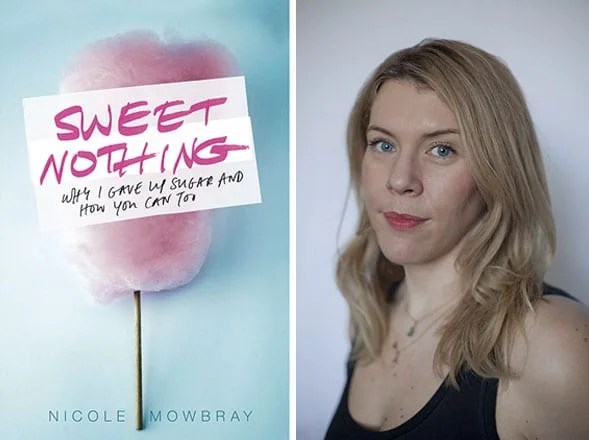
Hey sweetness, do you have a taste for the (re)finer treats in life? While those tasty sweets can create an immediate taste sensation, high-sugar diets are often the reason for feeling lacklustre too. That’s why author Nicole Mowbray wrote Sweet Nothing: Why I Gave Up Sugar And How You Can Too. “It’s tough giving up the sweet stuff,” explains Nicole. “Sugar is so entwined with our emotional happiness; sweet things are rewards, pick-me-ups and tokens of celebration.” In her book, part guide and part memoir, Nicole explains why life minus the sugar can be so much sweeter, and shares her personal journey from the up-and-down life of a sugar bon viveur to a slimmer, healthier woman in control and full of energy.
In this edited extract, Nicole explains how to identify the four sugars and what to kick and what to keep. For recipes, expert advice and a taste of Nicole’s own un-sugar-coated story, check out her website at www.sweetnothing.co.uk or read the full book, Sweet Nothing: Why I Gave Up Sugar And How You Can Too.
Know Your Sugars
‘There are effectively four types of sugar,’ says nutritionist Ian Marber. Let me explain this further.
1. Added sugar or refined sugar
This is either the spoonful you add to your morning tea, or the six teaspoons that are found in a can of Coca-Cola. It’s present in almost all processed foods, and processed foods are easy to identify. Basically, they bear little or no resemblance to their original ingredients. For example, shop-bought biscuits look little or nothing like their ingredients did in their natural state. Nutritionists are very concerned about the addition of fructose (a fruit sugar) to the majority of ready-made things that we buy in a highly processed form.
Fructose is bad because, unlike the other sugars, our body doesn’t produce a hormonal response to this sugar (as it does with insulin for other sugars) to remove it from our bloodstream. Instead, the body sends fructose straight to the liver to deal with it. ‘When the liver gets overwhelmed,’ says
Ian, ‘it begins converting fructose to liver fat, which can cause fatty liver disease. Nowadays, this is becoming increasingly common and it ups our chances of developing a degree of insulin resistance, thickened arteries and heart disease.’
Fructose also suppresses the body’s production of the hormone leptin, which tells you when you’re full. In other words, you can never get enough of it.
2. Foods that naturally contain high amounts of sugars that you don’t want
While not ‘unhealthy’, many fruits do contain high amounts of sugar – the exception are dark berries that are low GI (see below). Also wine, fruit juices and smoothies.
3. Foods that quickly convert to sugar in the body
These are easily identifiable by their GI (Glycaemic Index). ‘The Glycaemic Index is a scoring system to show how quickly something gives up its sugars’ says Ian. ‘Ultimately, to avoid blood sugar spikes we want the foods we eat to give up their sugars slowly, which means we receive the resulting energy evenly over a period of time. The scale is open to interpretation but I think of something scoring over 100 as having a high GI, something medium would be between 35 and 60, and a low GI food would be something that scores under 35.
‘A slice of white bread, for example, scores 100. While the Glycaemic Index is useful, it only tallies
up items individually and, of course, we rarely eat foods in isolation. If you are measuring a combination of foods it’s called a “glycaemic load”.
Here’s an example. Let’s say you have your piece of white bread which scores 100 on the chart, and you add jam to it. The jam scores 120, so you have 120 plus the bread, 100, totalling 220. Dividing this by two (as it’s comprised of two elements, the jam and the bread) gives you 110, which is still a really high glycaemic score. But how about if you have the piece of bread with peanut butter on it? Peanut butter has a very low GI, say 30. So you have 30 and you have your white bread which is 100, add them together and divide them by two, it’s 65. Now while that’s still high, it’s not as bad. It’s worth being aware that measuring a product’s GI is not a measure of health alone. Ice cream, for example, always scores low on the GI charts because it has lots of fat in it. Just looking at the Glycaemic Index alone is like looking at the calorie content of food without looking at the other nutritional information.’
4. ‘The masquerading sugars’ (as Ian calls them)
These include honey and agave. While these items are often less processed than sugar, they are still used by the body in very similar ways. At about 60 calories per tablespoon, agave contains more calories per gram than table sugar, which has 40.
‘The idea is this, just because something is “better” than something else, doesn’t mean it’s “good”,’ he says. ‘Loading honey and agave onto a bowl of porridge isn’t much better than loading it up with sugar. Often the difference is in the language used and the visual image it creates. When you think of honey you think of nature, bees, a nice sunny day, sunflowers, a lovely farmer in the countryside… When you think of sugar you think of plantations, factories, processing, the churning out of white granules, etc. But ultimately, from a nutritional standpoint, both are forms of sugar. We are not being duped by anyone, the public want to believe this [that some forms are better than others].’
Recipe: Spiced Crispy Kale Chips
Looking for a tasty snack to replace your 3pm sweet craving? Try these Spicy Crispy Kale chips – just one of the many great recipes from Nicole’s book, Sweet Nothing: Why I Gave Up Sugar And How You Can Too.
Kale chips are enjoying what fashion people would call ‘a moment’ right now. Kale is a much hyped superfood and it’s relatively inexpensive too. These are so easy to make and are great to have around when you’ve got the munchies.
INGREDIENTS
- 1 head of curly kale or 1 bag of pre-chopped kale (use as much as your baking tray will allow. The kale needs to be spread across the tray in a single layer)
- 1 large tomato
- 3 sun-dried tomatoes
- 1 teaspoon olive oil
- 1 garlic clove, crushed
- 1/2 teaspoon paprika
- 1/2 teaspoon ground cumin
- sea salt and freshly ground black pepper
METHOD
1 Preheat the oven to 180°C (350°F/Gas 4) and pop in a baking tray to warm up.
2 Wash and thoroughly dry the kale – any moisture will prevent the kale becoming crispy. Cut away and discard any stalks and place the kale in a large bowl. Bigger leaves work better for this as they don’t go crispy too quickly. Try to ensure the leaves you have are of a similar size.
3 Put the tomato, sun-dried tomato, olive oil and crushed garlic in a blender or food processor and pulse to a smooth paste. Add the paprika, cumin, and some salt and black pepper and blend again until smooth.
4 Scrape the mixture into the bowl with the kale leaves. Toss the kale about to ensure the leaves are all evenly coated with a thin spread of the mixture. The intention is to add flavour, not cover the leaves with a thick coating.
5 Spread the coated leaves evenly over the warmed baking tray in a single layer and place the tray high in the oven. Leave the oven door slightly ajar and bake for 20 minutes until crisp, turning the leaves halfway through. Be sure to keep an eye on them, as different ovens will take slightly different times to cook. Do not let the leaves burn; they will crisp up as they cool.
About Nicole
Nicole Mowbray is an established writer and former editor of Lifestyle and Femail of the Daily Mail. She has since written for Vogue, Grazia, The Times, the Guardian and Marie Claire.
Buy The Book!
Sweet Nothing: Why I Gave Up Sugar And How You Can Too, rrp $19.99, is published by Hachette Australia. Buy the book here.


