“Low tox” is everywhere on packaging right now, and it sounds like an easy thing to get behind. Because who doesn’t want less toxicity in their products? But ask five different brands what the term actually means, and you’ll get five different answers, because there’s no fixed definition behind it.
Low Tox Isn’t a Regulated Term
Much like “clean” or “natural,” “low tox” isn’t a legally defined category. There’s no governing body deciding what qualifies and what doesn’t, so it functions more as a formulating philosophy than a certification. Broadly, low tox beauty means formulating with the lowest possible toxic load – avoiding or minimising ingredients with known or suspected health concerns (certain synthetic fragrances, parabens, sulphates, PEGs and some UV filters) – rather than promising a product is entirely “toxin-free,” which isn’t a claim any product can accurately make.
“Low tox” is upfront about being a spectrum, not a binary. A brand can be meaningfully low tox without being 100% synthetic-free, and that’s a more realistic standard than chasing an impossible “zero” claim.
How is Low Tox Different From Clean or Natural Beauty?
- “Clean” beauty is largely a marketing category with no consistent definition – it often just signals “free from a list of ingredients this brand personally decided to avoid,” which varies wildly retailer to retailer.
- “Natural” beauty refers to ingredient origin (plant or mineral-derived vs. synthetic). But naturally-derived doesn’t automatically mean gentler, safer, or more effective — arsenic is natural too.
- “Low tox” beauty is specifically concerned with toxic load – the cumulative exposure to potentially harmful ingredients across everything you put on your skin, day after day, product after product.
The focus is less on where an ingredient comes from, and more on what it’s actually doing (or not doing) inside your body over time.
Why Low Tox Beauty is Gaining Ground
Skin is our largest organ, and we absorb a significant amount of what we apply to it – which is why toxic load has become a bigger part of the conversation. This isn’t about assuming every synthetic ingredient is dangerous (most aren’t, at approved concentrations). It’s about reducing unnecessary exposure where reasonably possible, particularly with products used daily, in high quantities, or on more absorbent, sensitive skin – SPF, body lotion, anything applied to children.
Sun care and family beauty naturally fit into this thinking. We apply sunscreen liberally and frequently, often to the most delicate skin in the house, making formulation choices especially important.
A Brand Doing It Well
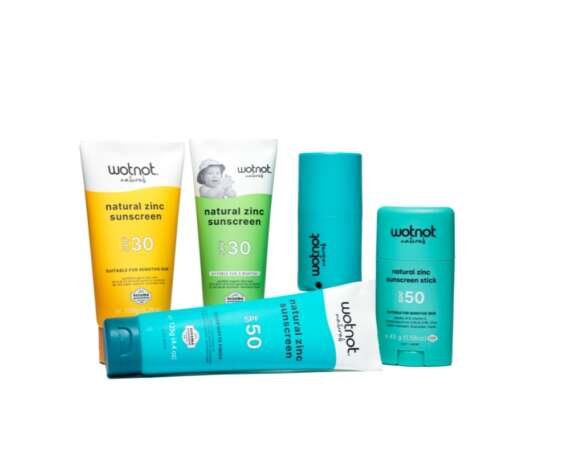
WotNot is a solid example of low-tox in practice, not just messaging. And its backstory explains why. Founded in 2006 by Sinead Roberts and Sioned Guard, the Australian brand grew out of a conversation between two mums rather than a boardroom pitch. “We didn’t set out to build a skincare brand, our customers built it for us,” says Sinead – a community-led ethos that’s since scaled into real category leadership: over 5 million products sold, and the number one baby sunscreen in Australian pharmacies, a notable feat for an independently owned, founder-led brand up against major conglomerates.
Zinc oxide sits at the centre of that reputation. Their Natural Sunscreen Roll-On SPF 30 uses a mineral UV filter and skips sulphates, petrochemicals and parabens while still delivering broad-spectrum protection – proof “low-tox” doesn’t mean under-formulated. Similarly, their Natural Baby Sunscreen SPF 30 applies the same principle to the family’s most sensitive skin, built on mostly edible-grade ingredients and TGA-approved from three months of age.
The BB Cream SPF 40 – a founder favourite, combining skincare, mineral makeup, high SPF and anti-ageing benefits – proves the same lens can extend to coverage and finish without compromise, and a new untinted SPF face sunscreen has since rounded out the range across every life stage. As Sinead puts it: “We have sold over 5 million products and we are just getting started.”
The Low Tox Low Down
Low tox beauty isn’t about perfection, and it isn’t interchangeable with “clean” or “natural,” even though the three get lumped together constantly. It’s a more grounded, evidence-minded approach: minimising unnecessary exposure where it’s genuinely possible, without pretending any product can promise “zero toxins.” That’s what makes it a more trustworthy standard than the vaguer labels currently crowding the shelf.