Most people these days know that switching off lights in a room not occupied, taking the bus instead of a car, and recycling are all very good things we as individuals can do to help care for the planet.
But there’s something else, something quite easy and seemingly small that you can do at home that, collectively, could make an even bigger contribution to the global effort to limit the earth’s warming to 2 degrees. That is:
Switch to refills. Wherever you can.
That’s it.
While governments and businesses can lead the charge in the take-up of renewable energy, this will only address 55 percent of emissions. The other 45 percent is attributed to the production and transportation of our food, clothes, cleaning products, skin care, medicines, hair straighteners, and so on. (Source: The IPCC and the Ellen Macarthur Foundation).
In other words, if we can make less stuff – including the packaging that we put stuff in – and if we can stop carting stuff around so much, we will affect a dramatic reduction in emissions.
Here’s why making stuff hurts the environment: Standard mass production processes rely on the extraction of ‘virgin’ or raw materials from the environment (from trees, grains, crops etc) and they tend to use a lot of water, a lot of energy (emitting greenhouse gases) and then generate a lot of waste (contaminated water, spent grains etc).
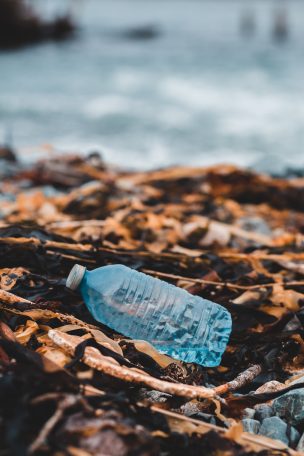
Now consider that much of this production is to make a plastic container that can only be used once to house a cleaning formula, a body wash, or a packet of chips. After much effort and environmental damage to produce one single use container, we go and toss it when we’re done. I can hear you say: “But what about recycling?!” Yes, a recycling bin is the best place to dispose of plastic but plastics are typically only recyclable once (the quality degrades). And you may have heard that less than 10 percent of plastic is actually ever recycled (according to National Geographic) – many forms of plastic, including the spring pumps typical of skin care packaging, are not easily recyclable.
Recycling has an important role to play in lowering emissions, but it is not the solution.
We’ve got to get better at producing less, and re-using what is already made. This means taking a low-emissions approach to product design, which inevitably also means we design ‘waste’ out of the system (because if we can reuse, reappropriate or re-purpose something, we’ve eliminated the need to produce it or make something else from scratch).
This is where refills come into the picture.
The concept is simple: Order a liquid or powder formula in a ‘forever’ container (or better yet, use a container you already have), and when you run out, refill that same container by sourcing the formula in a sustainable or circular form of packaging. Some companies, like Pleasant State and Resparkle provide their refills in biodegradable or compostable packets, while others like ZeroCo ask you to mail the refill packets back to them so they can be re-used. Refill home pick-up and delivery services are also emerging – ReCo is possibly the first in Australia. Buying from a bulk grocery store is another way to source formulations without any packaging.
Refills also typically come in concentrated formulas; Did you know that from skin care to cleaning solutions, many of the products we buy are mostly water? If we buy our products in a single use container, we buy a big bottle for a formula that is only about 5 – 10 percent active ingredient. The other 90 percent of that packaging is to house water. Talk about a waste of energy.
The Ellen Macarthur Foundation, a leading authority on the circular economy and climate change, estimates that replacing single use bottles with a refill option would affect an 80-85% reduction in greenhouse gas emissions due to packaging and transport savings.
Emma Lewisham, a New Zealand beauty brand declared the world’s first to produce a carbon positive product range, offers refillable product vessels that have up to a 74 percent smaller carbon footprint than that of the original packaging*.

“A linear business model that extracts resources and then wastes them is not sustainable,” says Emma Lewisham, founder of the benchmark-setting beauty brand. “For a business to truly be sustainable, it has to be circular. This means that we design out waste and pollution, we keep the materials we use in circulation, and we regenerate the ecosystems we operate in. And all of this is to be powered using renewable energy. This is business in the 21st century.”
I have personally made the switch to refillable laundry and dishwashing detergent, body wash, hand-wash, and toilet and all-purpose cleaner. It’s incredibly satisfying to see my recycling bin stay relatively free of plastics and to know that i’m contributing to a circular economy.