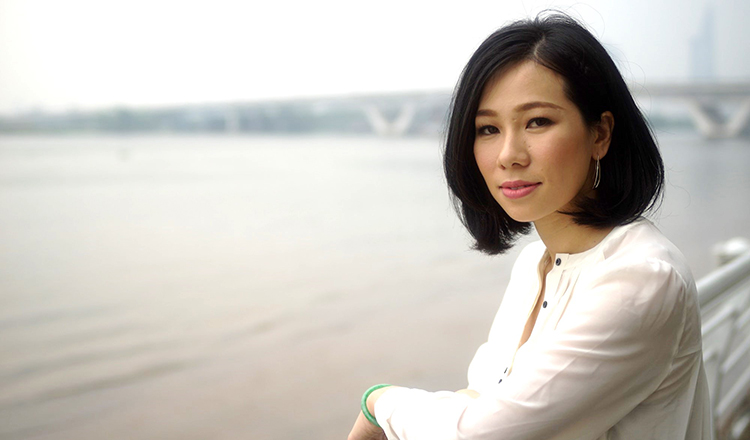
I was born 2 months premature in a former Thai prison weighing about 1.6 kilograms. Sikhiu refugee camp was situated on the Thai side of the Thai Cambodian border in a region surrounded by mountains. My father, a former banker was conscripted into the Southern Vietnamese republican army as a first lieutenant. After Saigon fell on the 30th April 1975 and the country was unified under Communist Vietnam, he was sent to a re-education camp.
My mother, a law student was forced to work as a rice farmer, back against the sun for hours feet planted permanently into the wet mud as the sun rose and sank indefinitely. After all her older brothers were sent to the camps, as the oldest in the family she was charged with her family’s survival. One of her brothers would not return for 10 years. My mother has two sisters and at the time after the war, they each shared one pair of pants. They couldn’t leave the house all at the same time. This sole pair of pants was patched again and again in a ridiculous ensemble of brokenness.
Not long after my father left the camp, he married my mother. The union was swift, desperate and humble – indicative of the times.
In the middle of the night in 1979, my mother sat silently seeped in sorrow: in the house where she had given birth to her son and before the ancestral altar where she had been married. The flood waters had long receded and the river was calm. Her mother, father, sisters and youngest brother wept in silence for fear the neighbors would guess my parents’ intentions and inform the authorities. Her two sisters held her tightly; sobbing violently into their hands cupped against their mouths in the pitch-dark. There was no way of knowing whether the group would survive the journey ahead of them. My mother’s lips trembled. The next day they left the only world they had ever known, uncertain of when and if they would ever return. The carnage, pain and trauma of the journey would be inconceivable.
There was no queue. My family left the only way that was most accessible to them. This was not by boat. It was by foot across the Moc Bai border in Tay Ninh Province, across Cambodia and into Thailand. My parents survived jungles riddled with landmines, severed heads and limbs as well as six refugee camps where women were raped.
We were eventually accepted by the Australian government and flew to Australia on a Qantas plane to start a new life. We arrived at Villawood Immigration Hostel (now Villawood detention centre).
We struggled very hard to build a life in Australia. I grew up in Western Sydney, mainly around Bankstown. As a child I witnessed the indignity of mute migrants, illiterate in this new language having to rely on their small child to translate documents and deal with insurance companies; the indignity of a former banker who loved reading Le Miserable, being abused on the factory floor; the indignity of a young desperate mother sewing for hours day and night in her self-imposed sweat shop to not only look after her immediate family but those in Vietnam who were literally starving; the indignity of not having certainty.
When I was 16 years old, my father came home from the factory one day – deeply despondent. He had an incident where other workers bullied him just for kicks. They sabotaged his machine on his shift. After years of silent rage, he was about to attack the worker – a blinded rabid dog. But he stopped. He told me that day ‘I have a mouth to eat with but I don’t have a mouth to speak with. You are my voice’.
And yet through our struggles, losing our home, picking ourselves up, my parents never lost hope. It was hope that kept their integrity intact, their grace and honor whole and their persistence to educate their children; their determination to just keep going, despite the severed Vietnamese heads; despite the overpaid bills, despite not speaking English, despite endless night shifts. Because we were free.
It was this backdrop that propelled me to study hard and try to not be a burden on my parents. I was the only Vietnamese student in my grade at Bethany College as well as the only student who didn’t have brand name shoes. I had sports shoes from Best & Less or Payless. I got a job as a 14 year old and saved up to buy my own first pair of glorious Nikes. I battled adolescent issues like bad skin but I knew that it paled in comparison to the hardship and pain my parents were enduring. I knew that they had only mute cries in this country. I therefore became involved in community development work especially regarding young people and migrant communities. I was selected as the Australian Youth Representative to the United Nations in 2004, the first person of refuge background and the first from Sydney University. Despite my education, I still struggled to find a sense of place. With Pauline Hanson, with my working class background at Sydney University law school, I felt I was a race and not a person. I needed permission to exist but it never came.
But with the persistence and resilience I learned from my parents, I pushed on. In between university, I went to Vietnam for a few months. It was there that I discovered more about my family history, through handwritten letters and oral stories. It was there that I went to the house my father grew up in. I touched the towering coconut trees that my grandfather planted. I touched the rice on the land that my mother worked on. I conversed with grandparents I never had in Australia. This physical and visible heritage compelled and romanced me. It was a powerful connection to ancestry that I had never experienced before and I longed for more. I returned to Australia refreshed at university and battled on.
On the day of my admission as a lawyer, I looked at my parents with their constant terrible memories hovering just underneath their skin, while they stood inside the New South Wales Supreme Court. I thought of landmines, of wet footprints in Cambodian jungles, of sewing machines, steel-capped boots, boxes of vegetables from wholesale markets and unpaid bills from far, far away, streaking around us like a snake of coloured lights. I saw a young woman huddled in the middle of the night in a rice field close to the Vietnam–Cambodia border, clutching a baby, as gun shots exploded in the dark. I saw a young man inside a barbed-wire compound, separated from his wife, ready to take his own life. And now they stood before me.
I sobbed into my father’s shoulder as he patted my back. All I could say was a muffled, ‘Thank you.’ It had been a long and turbulent journey. The three of us held each other awkwardly. I longed for us to be like that forever. We stayed like this for a long time, none of us knowing what to say, how to express all that we felt: that this was on some level, an arrival at a destination that for so long, our hearts and souls had humbly hoped for, silently suffered through, barely having enough courage to dream it would come true. As my mother finally pulled away, she squeezed my hand. She softly smiled through her tears as the staff ushered us towards the lifts.
We are here.
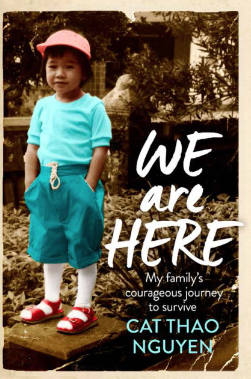
‘We Are Here’ by Cat Thao Nguyen is published by Allen & Unwin, RRP $24.99.