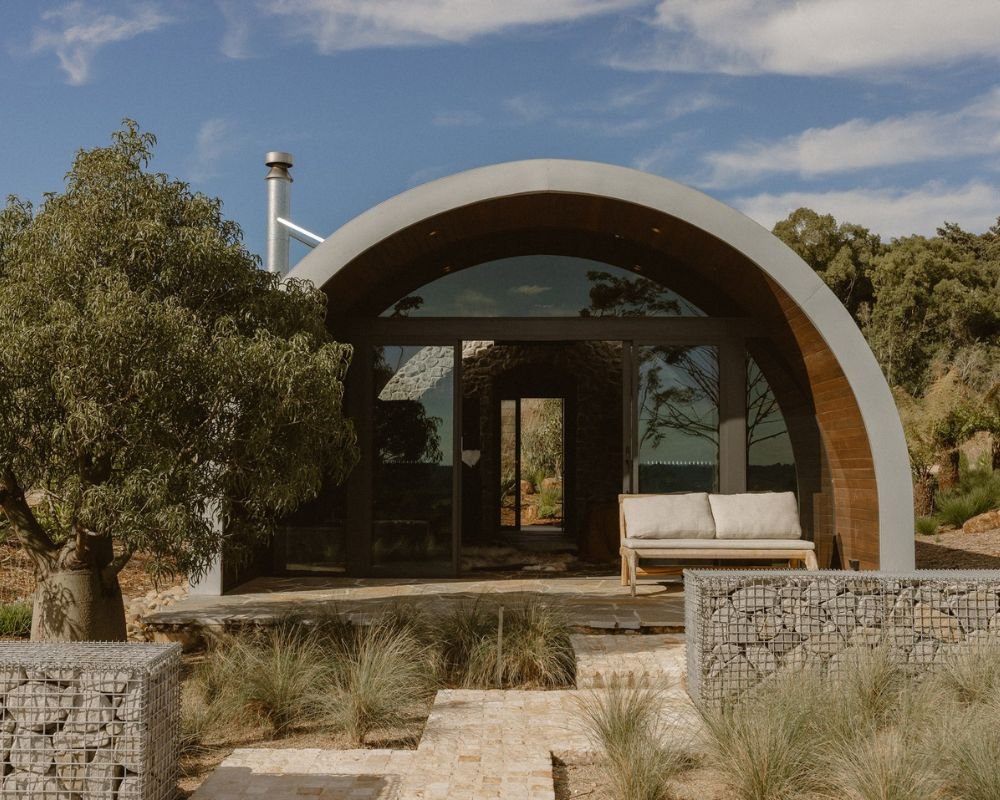
By early morning, before the mist has fully lifted off the valley, the loudest sound at Temple Hangars is birdsong. There is no traffic to compete with it, no neighbouring balcony, no ambient hum of a resort waking up around you – just timber warming under the first sun, and a silence so complete it registers almost as a texture. This, increasingly, is what luxury travel has come to mean: Stillness rather than spectacle. Not the room that photographs best, but the one that finally lets you stop performing rest and simply have it.
That recalibration – away from grandeur, toward restoration – has been building across the travel industry for a few seasons now, and nowhere in Australia is it being interpreted with more clarity than in the Northern Rivers. Perched high on a ridgeline in Nashua, just inland from Byron Bay, Temple Hangars is the latest and most ambitious project from Alita and Lawrence Temple, the couple behind the beloved Temple Farmhouse. Where the Farmhouse offered a restored country escape, the Hangars push the idea further: four architecturally distinct suites, each built less as a room to sleep in than a vantage point from which to actually notice the landscape around it.
The project began modestly, as an answer to demand – somewhere for the growing number of Farmhouse guests to stay. It didn’t stay modest for long. “We wanted something that was different,” Alita recalls. “Something attached to nature. Something with intention and purpose.”
That shift traces back to her own slow unlearning of what she thought mattered. Having spent her earlier years thinking in largely material terms, she found herself increasingly undone by the parts of life a floor plan can’t capture – grass underfoot, birds moving through the garden, the particular quality of afternoon light on a ridge. It’s that sensibility, more than any brief, that built Temple Hangars from the ground up.
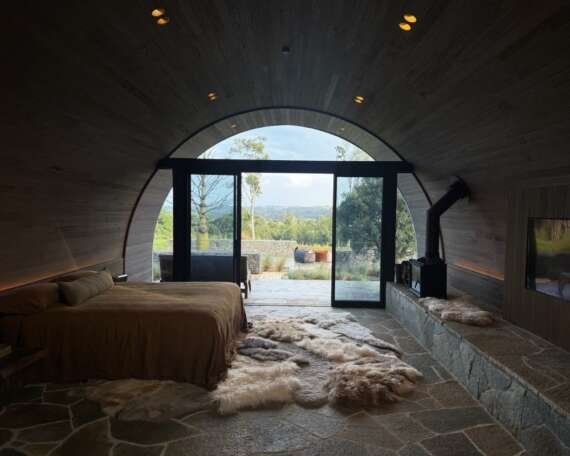
Architecturally, the result is disciplined to the point of quiet radicalism. There are no side windows – a deliberate omission. Glazing opens only toward each Hangar’s private courtyard and the valley beyond, framing the landscape rather than the neighbours, while skylights let daylight pour through by day and hand the ceiling over to stars once it’s dark. Thick insulated steel construction does something rarer still: it manufactures silence, the kind so absolute it becomes its own amenity. Lawrence describes the whole endeavour as “elegant, but restrained” – architecture that recedes on purpose, so the land can finally take the lead role it’s usually denied.
Each of the four Hangars carries a distinct temperament, less like variations on a theme than four separate ways of experiencing the same hillside. Booyong is the collection’s boldest gesture – unmistakably Australian, built from timber, stone and steel, robust yet held carefully in check so the view outside never loses the argument. Pepperberry runs softer and more romantic: vaulted ceilings, hand-finished micro cement, a private courtyard arranged around a still, mirror-flat pond. Sassafras makes the boldest statement of the four – Alita calls it her “Wabi Sabi dinosaur jungle”, where Japanese restraint meets lush, almost feral planting and blurs the line between interior and garden. And Coolamon, the property’s fully accessible suite, borrows from Nordic minimalism – pale timbers, clean architectural lines, the calmest and most pared-back note in the collection.
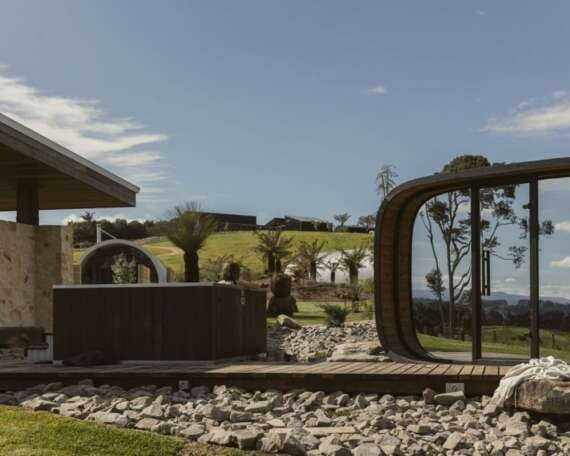
Beyond the private suites, a stone-and-reclaimed-timber pavilion holds the property’s communal life together – built for long lunches, unhurried dinners, mornings with nowhere urgent to be. A cedar hot tub and sauna sit folded into native gardens close by, less an amenity checklist item than an actual invitation to stop moving. Here, away from the individually styled interiors, Temple Hangars reveals its real intention: the owners designed it for living, not simply admiring, just as they live on and with the land themselves.
That same instinct extends outward into the region itself. The Northern Rivers has spent decades quietly gathering architects, ceramicists, growers and chefs drawn to its slower pace, and Temple Hangars draws directly from that creative well rather than importing polish from elsewhere. Lighting by Christopher Boots, handmade ceramics, original local artwork, French linen robes, organic Mullumbimby skincare – nothing here reads as sourced so much as collected, gathered over time by people who actually know the makers. “It was really important to me to use people who were actually creating things,” Alita says, and the property carries that intention in every surface: less a curated hotel room, more someone’s considered, well-loved home.
Days unfold without much shape, which is rather the design. Mornings might mean coffee in the courtyard while mist still sits low over the valley floor; afternoons, a wander through Bangalow’s cafés and providores, or a swim at a waterfall a short drive away, before the light turns gold again over Nashua and the hot tub starts making its case. Guests tend to arrive curious about the architecture and leave remembering something quieter and harder to photograph – the birds at first light, warm timber underfoot, an evening with genuinely nowhere else to be.
At a moment when travel keeps rewarding the loudest, most photogenic gesture, Temple Hangars is doing something more difficult and, in the end, more memorable: building a place that asks for almost nothing, so that everything around it can finally be heard.